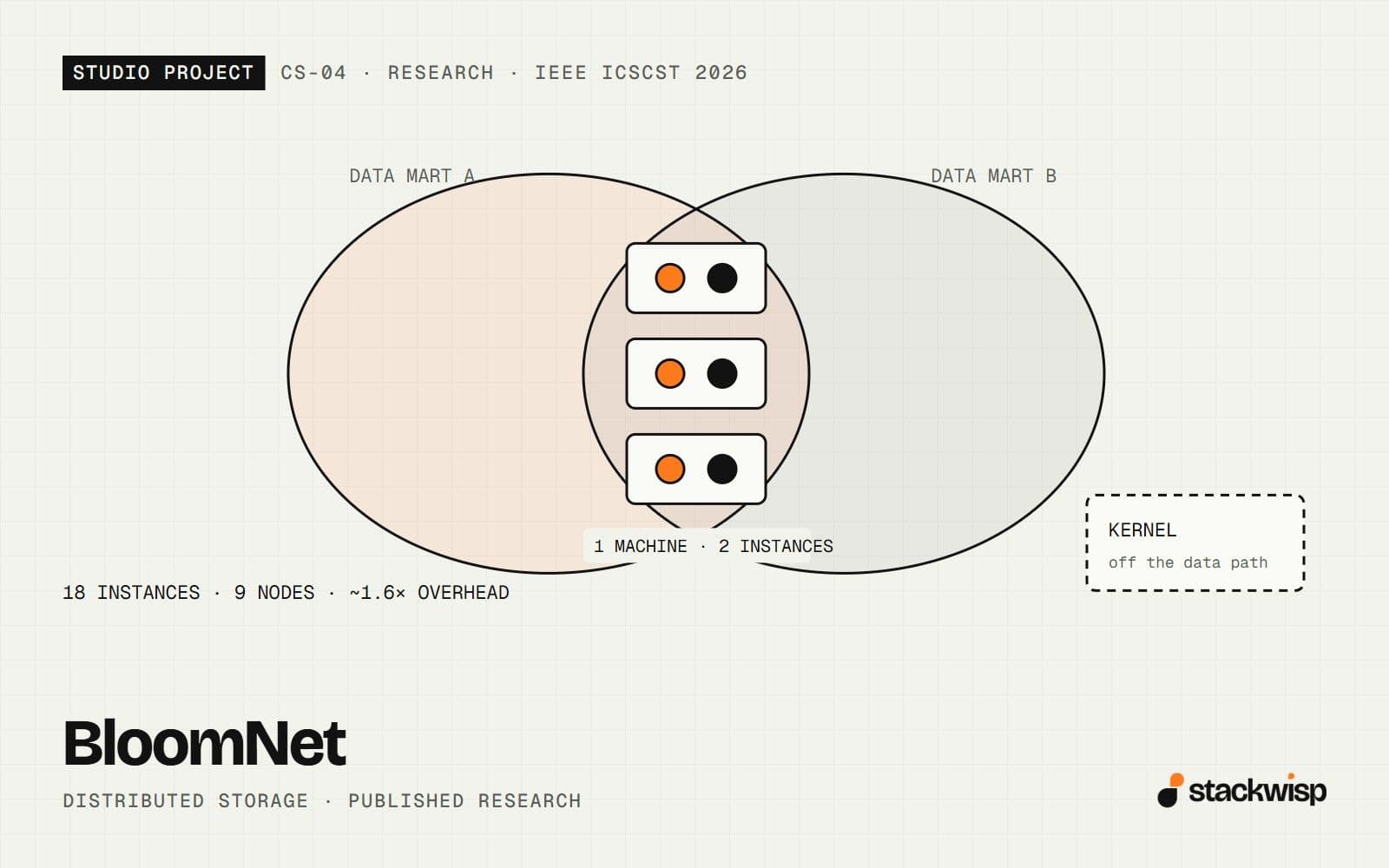
BloomNet is self-hosted object storage for teams that run their own hardware and cannot afford downtime. Each machine belongs to two overlapping storage clusters, so when something fails the damage stays contained and nothing has to be rebalanced. The design was peer-reviewed and published at IEEE ICSCST 2026.
- Project
- StackWisp studio project
- Industry
- Infrastructure and storage
- Built with
- Python · FastAPI · MinIO · Neo4j · Tailscale · Prometheus · Grafana · Docker
What it is
Storage usually forces a choice. A central design is simple to run but depends on one master node. A fully decentralised design removes that weak point but spends much of its effort keeping every node in agreement. BloomNet sits in between.
How it works
- Two instances per machine. Every machine runs two storage instances, each in a different cluster, so every machine sits in two overlapping clusters at once.
- Failures stay small. If one instance goes down, the other keeps serving, and there is no global cluster to reshuffle.
- Grows by branching. New machines form new clusters instead of enlarging one giant ring.
- Control off the data path. A separate control plane, the Kernel, manages the network, so reads and writes keep flowing even when it is down.
- Secure by default. Machines talk over an encrypted zero-trust mesh, and erasure coding keeps storage overhead low.
What it showed
On an 18-instance test network, with storage instances deliberately shut down while it ran, BloomNet kept data available without a rebalance, caught failures in under 15 seconds, and used about 1.6× the raw data size on disk, against 2× for simple mirroring.
What we built
- The storage network, with MinIO instances arranged as overlapping clusters.
- The Kernel control plane, with FastAPI and a Neo4j record of every node, which adds new machines to monitoring as they join.
- Monitoring from day one with Prometheus and Grafana.
- One-command setup for the whole stack with Docker Compose.
Source code: GitHub: MihirPanpatil/BloomNet · GitHub: MihirPanpatil/BloomNet-Kernel · GitHub: MihirPanpatil/BloomNet-DataNode
The same disciplines go into every system we host for partners: fault isolation, monitoring, secure networking between machines, and infrastructure you can rebuild from a file.